Introduction
For my project, I performed a text analysis of Henry David Thoreu’s Walden. Specifically, I used Voyant Tools to look at different word frequencies, associations, and themes throughout the text. Overall, I found that different words peaked during different chapters, demonstrating how the subjects change throughout the course of the book, and that, though mentions of thematic words like “nature” and “town” appeared close together, the contexts of these words were distributed quite differently.
Sources
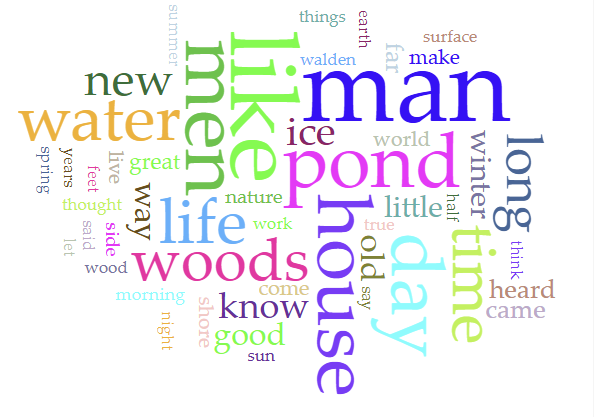
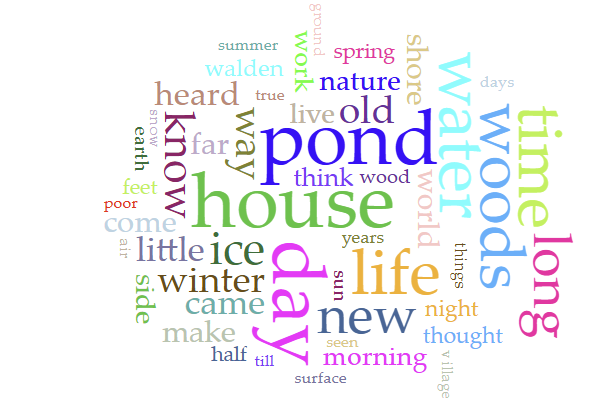
I used the Project Gutenberg version of Thoreau’s Walden as my main dataset. As is often the case, Walden was originally combined with Thoreau’s other essay, On Civil Disobedience, in the same file. I only wanted to focus on Walden, so to remove this other text, I simply opened the raw text file in Google Docs and deleted it—as well as the extra front and back matter—manually. Then, I redownloaded this updated data as a .txt file and imported it into Voyant. Though Voyant does automatically create a stopwords list based on the text, I found that it still did not pick up on all distracting, common words—for instance, when the text originally loaded, Voyant said “like” was Thoreau’s most used word. This meant that I had to go in and further edit the stopwords list by hand. Some of the words I edited out included “like,” “say,” “said,” “quite,” “went,” etc. Once I did that, I was able to get a better sense of the sort of themed words Thoreau was using, allowing me to better search the text for different topics and associations.
Processes
The first thing I did with this cleaned text in Voyant was consider which words were most common. Voyant automatically visualizes this as a word cloud; I saw that the five most frequent words in the corpus were “pond,” “house,” “day,” “life,” and “water,” which makes sense as the book is essentially a record of Thoreau’s life at Walden Pond. I then played around with Voyant’s visualization tool—“trends”—to see how the frequencies of different words changed over time.
Above is an interactive display of the top five most common words used in Walden from Voyant!
One particularly interesting trend I observed was that the words “nature” and “town” were highly correlated throughout the text. However, the contexts they are most associated with were very different. Using Voyant’s Links tool, I was able to compare the terms that show up most often alongside each word. I noticed that “town” was also related to “woods,” as well as others such as “poor” and “house;” this made me think that Thoreau intended to compare life in town with life in nature. Similarly,” “nature” was related to “life” and “lives,” which aligns with the fact that Thoreau was writing about his life in the woods.
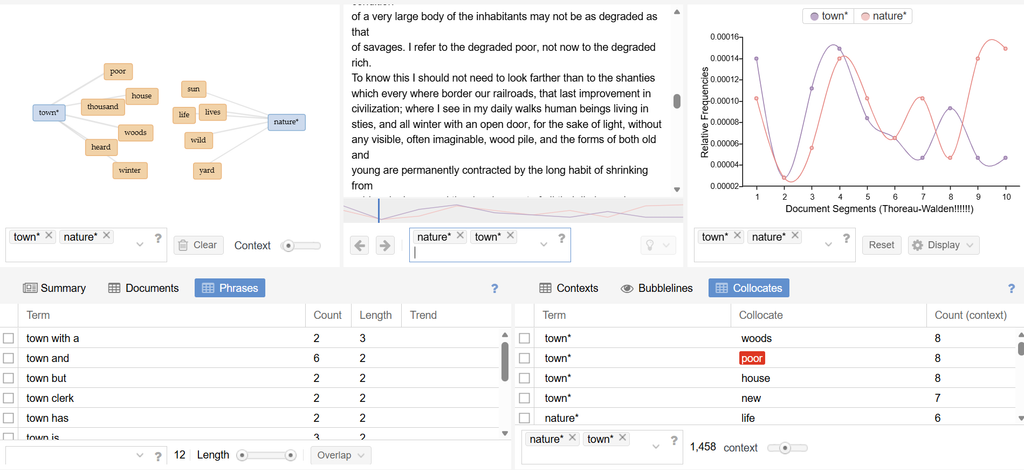
Going off of this, I wanted to track some of the connotations of the words associated with “nature” and “town.” I continued to use the trends tool, as I found this to be the most helpful tool when visualizing word trends over the whole of a text, but this time, I entered word relationships rather than simply words.
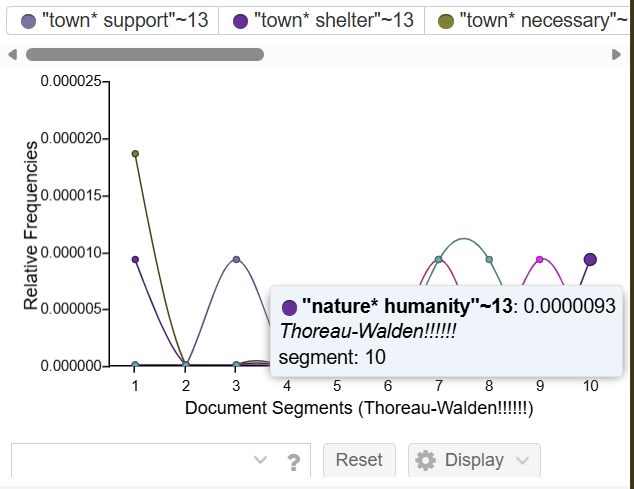
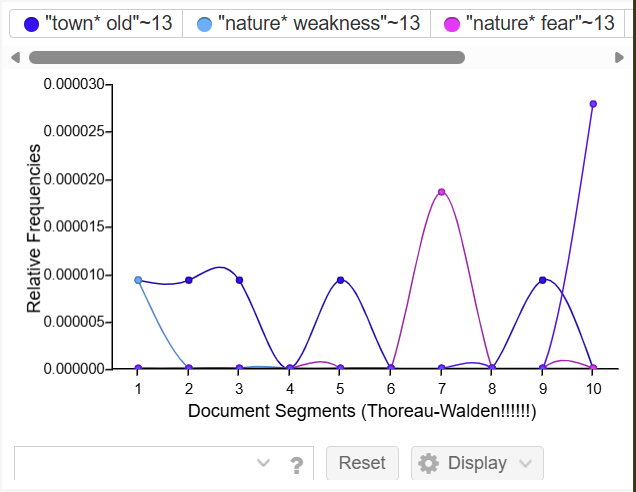
The full key at the top of the image got cut off, but essentially, I noticed that positive word associations with “town” tended to be higher toward the beginning, and vice versa for “nature.” Negative word associations tended to be fairly evenly distributed for each word; however, I noticed that the more passive negative word associations with “nature,” such as “weakness,” tended to be higher at the beginning and nearly disappear toward the end. More active words, such as “fear,” and “brute” became more popular associations toward the end. I wonder if, as he spent more time in the woods, Thoreau began to view nature as a more unpredictable, living being—could the word trends here signify this change in mindset?
Presentation
When choosing how to present my findings, I wanted my website to be as straightforward as possible. I chose the “Twenty Twenty-Four” theme, as I found it to be the easiest to navigate and customize, and changed the background color to gray-blue since I felt it was less harsh than the pure white. I included images that showed the most essential parts of my process so the reader could follow along, and I wanted to embed the visualization of the top five words as it allows to reader to see and interact with a few different word trends without the graph getting too busy. I wanted to embed it toward the beginning of my page so that the reader could better understand how Voyant works by interacting with it before showing them the images from the rest of my process.
Significance
Overall, I found distant reading to be a very helpful activity with regard to understanding a text. It is difficult to track words and themes while reading an entire, long text; distant reading and text analysis make this process much more straightforward. I found that being able to examine the frequency of different words and word relationships allowed me to better understand Walden as a whole, though it did leave me with questions. Still, I wonder about the specific contexts in which nature was referred to negatively—did Thoreau face any specific challenges when he used those words? Did he provide any examples of towns that were “poor?” In this way, I think combining a digital humanities approach with distant reading and a traditional close reading could be very valuable to understanding a text in the future.